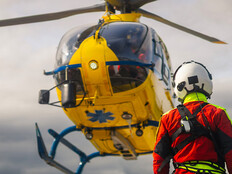







Expanding Intelligence for Law Enforcement and Emergency
For law enforcement, drones offer an “eyes on scene” capability. They provide overwatch, improve situational awareness and allow officers to assess environments before entering them. That expanded operational picture can reduce risk and lead to better-informed decisions in real time.
In fire and search-and-rescue scenarios, the focus shifts slightly. While drones can identify hot spots using thermal imaging, often their greatest value is in locating people quickly — especially in complex or dangerous environments. Time is critical in these situations, and drones help responders cover more ground faster.
Emergency management teams take an even broader view. During floods, severe weather events or large-scale incidents, drones provide a comprehensive perspective — monitoring water levels, assessing infrastructure and supporting resource distribution efforts. They bring together the capabilities of law enforcement and fire services in a unified operational tool.
Across all of these use cases, the common thread is visibility. Drones extend what agencies can see, understand and act on — and that’s a powerful advantage.
READ MORE: Local agencies identify video storage solutions.
New UAV Technology and Policies Are Driving Adoption
The rapid adoption of drones in public safety isn’t happening by accident. It’s being fueled by meaningful advancements in both policy and technology.
One of the most important developments has been the ability to operate beyond visual line of sight. Historically, drone operators were required to maintain constant visual contact with their aircraft. Today, with FAA waivers and the right safeguards in place, agencies can deploy drones remotely — enabling faster response times and centralized control.
That shift is supported by improvements in autonomy, particularly object detection and avoidance systems. Modern drones can navigate around obstacles like power lines, buildings and other hazards without relying solely on a pilot’s input. This capability not only enhances safety but also expands where and how drones can be used.
Payload innovation is another game changer. Today’s drones can carry high-resolution cameras, thermal sensors and even specialized equipment for specific missions. I’ve seen demonstrations where drones capture incredibly detailed imagery — with resolutions measured in centimeters — enabling applications such as crime scene reconstruction and infrastructure inspection at a level that wasn’t possible just a few years ago.
Artificial intelligence is accelerating all of this. AI helps process massive amounts of visual data, supports automated redaction for privacy and enables smarter routing and dispatch. Instead of relying on manual review or static flight paths, agencies can leverage machine learning to make faster, more informed decisions throughout a mission.
The result is a platform that’s not just more capable but also more practical for everyday use.
LEARN MORE: Government officials consolidate fragmented tools with platforms.
Building a Mission-Driven Drone Program for Public Safety Agencies
For agencies that are just getting started, the most important step isn’t selecting a drone, it’s defining the mission.
I always advise organizations to begin with three questions:
- What is the desired mission outcome?
- Who is responsible for decision-making?
- How will the data be used once it’s collected?
Those answers shape everything that follows. They influence the type of drone platform you choose, the software you deploy and how you integrate drones into existing workflows. Without that clarity, agencies often find themselves reacting to technology decisions instead of driving them.
Another critical consideration is collaboration. Drones are rarely confined to a single department. I’ve seen fire departments support law enforcement operations, utilities teams assist emergency management and transportation agencies leverage drones for inspections that also enhance public safety. The most successful programs are built with this kind of cross-functional use in mind.
Finally, agencies need to think about data. Drones generate significant volumes of imagery and video, and that information must be stored, analyzed and, in some cases, shared securely. Planning for data management up front ensures that the insights drones provide can be acted upon.
Drones are no longer an emerging technology for public safety — they are becoming foundational. As capabilities continue to advance, agencies that take a strategic, mission-driven approach to using drones will be best positioned to unlock their full value and better serve their communities.